My Edible Garden

Edible Landscaping the Backyard

Sustainable Living

It's not that hard.

Showing posts with label Articles. Show all posts

Tuesday, December 15, 2009

What the Experts Won’t Eat

microwave popcorn From Prevention Magazine

How healthy (or not) certain foods are for us, is a hotly debated topic among experts and consumers alike, and there are no easy answers. But when Prevention talked to the people at the forefront of food safety and asked them one simple question—“What foods do you avoid?”—they got some pretty interesting answers. And their answers are, well, food for thought:

1. Canned Tomatoes

The expert: Fredrick vom Saal, PhD, an endocrinologist at the University of Missouri who studies bisphenol-A

The problem: The resin linings of tin cans contain bisphenol-A, a synthetic estrogen that has been linked to ailments ranging from reproductive problems to heart disease, diabetes, and obesity. Unfortunately, acidity (a prominent characteristic of tomatoes) causes BPA to leach into your food. Studies show that the BPA in most people's body exceeds the amount that suppresses sperm production or causes chromosomal damage to the eggs of animals. "You can get 50 mcg of BPA per liter out of a tomato can, and that's a level that is going to impact people, particularly the young," says vom Saal. "I won't go near canned tomatoes."

The solution: Choose tomatoes in glass bottles (which do not need resin linings), such as the brands Bionaturae and Coluccio. You can also get several types in Tetra Pak boxes, like Trader Joe's and Pomi.

2. Corn-Fed Beef

The expert: Joel Salatin, co-owner of Polyface Farms and author of half a dozen books on sustainable farming

The problem: Cattle evolved to eat grass, not grains. But farmers today feed their animals corn and soybeans, which fatten up the animals faster for slaughter. More money for cattle farmers (and lower prices at the grocery store) means a lot less nutrition for us. A recent comprehensive study conducted by the USDA and researchers from Clemson University found that compared with corn-fed beef, grass-fed beef is higher in beta-carotene, vitamin E, omega-3s, conjugated linoleic acid (CLA), calcium, magnesium, and potassium; lower in inflammatory omega-6s; and lower in saturated fats that have been linked to heart disease. "We need to respect the fact that cows are herbivores, and that does not mean feeding them corn and chicken manure," says Salatin.

The solution: Buy grass-fed beef, which can be found at specialty grocers, farmers' markets, and nationally at Whole Foods. It's usually labeled because it demands a premium, but if you don't see it, ask your butcher.

3. Microwave Popcorn

The expert: Olga Naidenko, PhD, a senior scientist for the Environmental Working Group,

The problem: Chemicals, including perfluorooctanoic acid (PFOA), in the lining of the bag, are part of a class of compounds that may be linked to infertility in humans, according to a recent study from UCLA. In animal testing, the chemicals cause liver, testicular, and pancreatic cancer. Studies show that microwaving causes the chemicals to vaporize—and migrate into your popcorn. "They stay in your body for years and accumulate there," says Naidenko, which is why researchers worry that levels in humans could approach the amounts causing cancers in laboratory animals. DuPont and other manufacturers have promised to phase out PFOA by 2015 under a voluntary EPA plan, but millions of bags of popcorn will be sold between now and then.

The solution: Pop natural kernels the old-fashioned way: in a skillet. For flavorings, you can add real butter or dried seasonings, such as dillweed, vegetable flakes, or soup mix.

4. Nonorganic Potatoes

The expert: Jeffrey Moyer, chair of the National Organic Standards Board

The problem: Root vegetables absorb herbicides, pesticides, and fungicides that wind up in soil. In the case of potatoes—the nation's most popular vegetable—they're treated with fungicides during the growing season, then sprayed with herbicides to kill off the fibrous vines before harvesting. After they're dug up, the potatoes are treated yet again to prevent them from sprouting. "Try this experiment: Buy a conventional potato in a store, and try to get it to sprout. It won't," says Moyer, who is also farm director of the Rodale Institute (also owned by Rodale Inc., the publisher of Prevention). "I've talked with potato growers who say point-blank they would never eat the potatoes they sell. They have separate plots where they grow potatoes for themselves without all the chemicals."

The solution: Buy organic potatoes. Washing isn't good enough if you're trying to remove chemicals that have been absorbed into the flesh.

5. Farmed Salmon

The expert: David Carpenter, MD, director of the Institute for Health and the Environment at the University at Albany and publisher of a major study in the journal Science on contamination in fish.

The problem: Nature didn't intend for salmon to be crammed into pens and fed soy, poultry litter, and hydrolyzed chicken feathers. As a result, farmed salmon is lower in vitamin D and higher in contaminants, including carcinogens, PCBs, brominated flame retardants, and pesticides such as dioxin and DDT. According to Carpenter, the most contaminated fish come from Northern Europe, which can be found on American menus. "You can only safely eat one of these salmon dinners every 5 months without increasing your risk of cancer," says Carpenter, whose 2004 fish contamination study got broad media attention. "It's that bad." Preliminary science has also linked DDT to diabetes and obesity, but some nutritionists believe the benefits of omega-3s outweigh the risks. There is also concern about the high level of antibiotics and pesticides used to treat these fish. When you eat farmed salmon, you get dosed with the same drugs and chemicals.

The solution: Switch to wild-caught Alaska salmon. If the package says fresh Atlantic, it's farmed. There are no commercial fisheries left for wild Atlantic salmon.

6. Milk Produced with Artificial Hormones

The expert: Rick North, project director of the Campaign for Safe Food at the Oregon Physicians for Social Responsibility and former CEO of the Oregon division of the American Cancer Society

The problem: Milk producers treat their dairy cattle with recombinant bovine growth hormone (rBGH or rBST, as it is also known) to boost milk production. But rBGH also increases udder infections and even pus in the milk. It also leads to higher levels of a hormone called insulin-like growth factor in milk. In people, high levels of IGF-1 may contribute to breast, prostate, and colon cancers. "When the government approved rBGH, it was thought that IGF-1 from milk would be broken down in the human digestive tract," says North. As it turns out, the casein in milk protects most of it, according to several independent studies. "There's not 100% proof that this is increasing cancer in humans," admits North. "However, it's banned in most industrialized countries."

The solution: Check labels for rBGH-free, rBST-free, produced without artificial hormones, or organic milk. These phrases indicate rBGH-free products.

7. Conventional Apples

The expert: Mark Kastel, former executive for agribusiness and codirector of the Cornucopia Institute, a farm-policy research group that supports organic foods

The problem: If fall fruits held a "most doused in pesticides contest," apples would win. Why? They are individually grafted (descended from a single tree) so that each variety maintains its distinctive flavor. As such, apples don't develop resistance to pests and are sprayed frequently. The industry maintains that these residues are not harmful. But Kastel counters that it's just common sense to minimize exposure by avoiding the most doused produce, like apples. "Farm workers have higher rates of many cancers," he says. And increasing numbers of studies are starting to link a higher body burden of pesticides (from all sources) with Parkinson's disease.

The solution: Buy organic apples. If you can't afford organic, be sure to wash and peel them first.

Monday, November 30, 2009

Thanksgiving-the fallout

Thanksgiving TurkeyI hope everyone had a great Thanksgiving. Of course the fallout after this huge meal is the guilt. After all, we’re eating upwards of 3,000 calories. Luckily Lean Cuisines are on sale at the grocery store. Maybe I can eat those at least until Christmas. :-)

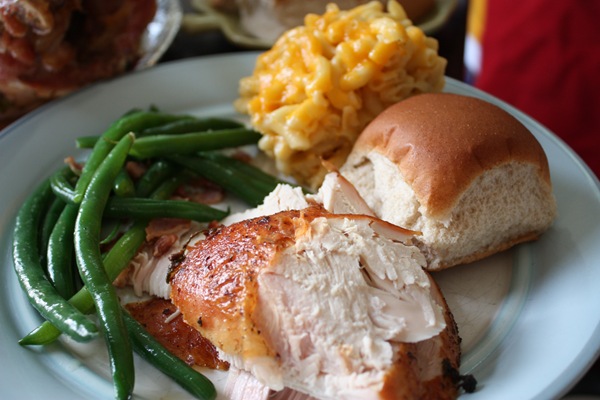
Thanksgiving MealThanksgiving is centered around the food. But this year I didn’t even have to cook. It’s good to know a chef. He put together this great meal for us.

Homemade Macaroni and CheeseA wonderfully brined and moist turkey with macaroni and cheese, green beans and bacon and dinner rolls (store bought). We also had the choice of three deserts; chocolate cake, peach pie with a crumb topping, and sweet potato pie. I loved the sweet potato pie because it had a non-gummy texture and wasn’t overly spiced so the sweet potato flavor came through.

ZoieZoie's Thanksgiving BowlEven Zoie, my smart little border collie mix, got a Thanksgiving plate. You can see her extremely worried face as if she wasn’t going to get anything. But she got all the fixings and she even ate the green beans. It probably helped they were cooked in bacon.

Green Beans and Bacon

So I hope everyone had a great Thanksgiving. Now I need to prepare for Christmas, and that means cookies. I’m sure I’ll be testing a few recipes that you’ll see here soon. Wish me luck!

Sunday, November 22, 2009

Oh No! Where’s My Eggo?

Kellogg is rationing its Eggo products due to flooding and equipment problems at two bakeries. The shortfall could last through mid-2010.

Flooding at an Atlanta bakery during heavy rains in October forced Kellogg to shut down production temporarily. Plus, equipment at Kellogg's largest waffle facility, based in Rossville, Tenn., needs extensive repairs.

Apparently remaining inventory will be rationed to stores across the country based on historical percentage of business.

You could always make waffles from scratch or with homemade Bisquick. It’s almost as fast as the toaster, and probably tastes better too.


Monday, October 26, 2009

review: Ketchum Grill - Ketchum, Idaho

Ketchum Grill During my recent trip to the Trailing of the Sheep festival in Ketchum, Idaho, we knew we had to stop for a nice dinner somewhere. After looking at restaurants online and some of their reviews, we settled for the Ketchum Grill.

We had reservations at 8pm and the place was packed. Luckily at the entrance you’re met with some nice chairs and a very warm fireplace while you wait for your table.

Once we were called, we were seated at a small table for two, where I had to squeeze in hoping not to knock anything off a fellow diner’s table. They had the night’s specials on the wall and quite a few large parties. Our drink orders were taken and a few minutes later we were presented with some great bread.

One slice seemed to be wheat and had walnuts and a fruit of some kind and tasted nutty and flavorful. Another slice was white with fruit and also tasted great. I didn’t ask what kind it was, I just ate it.

Ketchum Grill By this time my water was empty, and the waiter seemed to disappear from our table. He was doing the best he could. Management seemed to give him a whole section of about 6-7 tables and one of those had a party of eight. I’m not sure what they were thinking because he couldn’t keep up.

Slow Roasted Lamb It took a while but then our food finally came. My mom ordered slow roasted lamb with Indian spices and mint yogurt (it was a sheep festival after all). I ordered the grilled peppered breast of duck with Idaho huckleberries and port.

I snuck a bite of the lamb and it was OK. It tasted like pot roast. For some reason I expected something a little more, especially with the price attached to it. It wasn’t dry but imagined it would be in some kind of wonderful pan juices. I’m not sure where the Indian spices were, because they weren’t in the meat. The mint yogurt didn’t really add anything to the dish when the meat was supposed to be the star. Basically, I could have made pot roast at home for a lot cheaper.

 Peppered Duck with Wild Huckleberries I ordered my duck medium. It was topped with an Idaho huckleberry sauce alongside some wild rice. The sauce wasn’t overly sweet and tasted pretty good. The duck breast was tough. I could barely cut through one of its stringy tendons inside the breast. I wasn’t pleased, but I ate it anyway. I’ve made duck breast at home twice, by roasting it. One time it came out wonderful and tender. Another time it came out tough. Perhaps it’s just a finicky bird to cook.

Inside Out German Chocolate Cake It was now time for dessert. We were full, but we weren’t going to leave without some dessert. My mom ordered the inside out German Chocolate Cake. Broiled coconut-pecan topping was layered in between rich chocolate cake, and topped with an almost too rich chocolate ganache.

Pumpkin Brioche Bread Pudding I ordered the pumpkin brioche bread pudding with salted caramel ice cream. It was awesome. The pumpkin flavor was pronounced but not overdone and the housemade ice cream was creamy and delicious. The middle of the bread pudding wasn’t as warm as the outside, so I assume it was reheated, but I ate through that too. I wouldn’t want anything to go to waste.

Overall it was an OK place to eat, and my mom seemed happy. But it wouldn’t be my first choice. I’d need to experience the other fine dining hot spots in Ketchum, before giving Ketchum Grill a second look.

Monday, October 19, 2009

field trip: Trailing of the Sheep Festival

Trailing of the Sheep FestivalLast week I traveled from St. Paul to my home state, to take my mom to a Ketchum, Idaho tradition; The Trailing of the Sheep Festival. It’s a weekend of food, events and shows centered around the culture of sheep in Idaho. You’ll find traditional Basque and Pervuian dancers, sheep dog training and trials, barbecues and local restaurants preparing lamb dishes for all to try.

The main event is a parade, but it’s not your normal event. Main Street is shut down, thousands of people line the streets and 1500 sheep are herded right through town.

Sheepherder WagonTraditional wagons that sheepherders live in, pulled by beautiful horses were the first “floats” to take the trek through Main Street. I don’t remember what kind of horses these are but they are huge and have amazing color.

Peruvian DancersDancersNext, Polish, Basque and Peruvian dancers delighted the crowd with synchronized dances that have a long history in their culture.

Trailing of the Sheep FestivalTrailing of the Sheep FestivalThe sheep were late and the chilly wind was brisk. My teeth were chattering toward the end but at least the sun was shining. Finally, an hour late, the sheep were finally spotted at the end of Main Street. They were moving at a fast pace, and it didn’t look like 1500 sheep, but there they were, packed into Main Street. Apparently every black-faced sheep represents 100 white-faced sheep. I’m guessing this helps the herders keep track of their flock. The sheep were not moving at a leisurely stroll. It seemed like they were gone in about 15 seconds, so getting a good picture was a roll of the dice.

Trailing of the Sheep FestivalTrailing of the Sheep Festival

Starbucks Ketchum, IdahoIt’s now the home to Starbucks, but in 1936 it was a general store. It served as the sheep center where ranchers congregated to swap stories about prices and weather. It’s at the corner of Main Street and Sun Valley Road.

Tatra Sheep DogPolish sheep dogs called Tatras also roamed by for parade-goers to pet.

Sheep through Main Street is quite a sight but you’ll want to watch your step after the sheep leave. Once the parade was done, we hurried to get some soup and a burger to warm up.


For more history on the event, here’s my other blog post.


Friday, October 9, 2009

Happy Trails Ahead

TrailingSheepFest6 Today I’m off and flying to my hometown in Idaho to visit my Mom. This weekend I’ll be taking her to see the Trailing of the Sheep Festival in Ketchum, Idaho. Of course, I’ll be taking my camera to capture the fun and hopefully we’ll be stopping at some good places to eat on the way.

Here’s a little history of the Trailing of the Sheep Festival and what I have to look forward to…

Sheep figure prominently in the history of man providing him food and fiber for clothing. The story of sheep fills the pages of western Asia and European history. England and Spain were large producers in the middle ages and introduced the animals into the New World. Those in the western United States were brought in by the Spanish through South America and Mexico in the 16th and 17th century.

In the south west region of Idaho, it is said that John Hailey brought the first sheep into the Wood River Valley in the late 1860's. At that time, Idaho recorded a breeding sheep population of 14,000. As the mines began to play out in the Wood River Valley, the sheep industry filled an increasingly large role in the local economy. By 1890 there were a reported 614,000 sheep in Idaho. A 1905 newspaper photograph of a shearing plant in neighboring Picabo states that 95,000 sheep were sheared that week. In 1918 the sheep population reached 2.65 million*, almost six times the state's human population. (It was not until the 1970 census, after a large decline in the sheep industry and an influx of new residents, that human numbers finally exceed sheep in Idaho - 700,000 to 687,000.)

During this time, thousands of lambs were shipped by railroad from Hill City, Fairfield, Picabo, Bellevue, Hailey and Ketchum to markets around the west. As a major sheep center, Ketchum was second only to Sydney, Australia.

When Sun Valley was opening its winter ski resort in 1936, sheepman Jack Lane was holding forth at his general store in Ketchum. It served as the sheep center where ranchers congregated to swap stories about prices and weather. Today the building is still located at the corner of Main Street and Sun Valley Road and houses Starbucks Coffee.

During the depression, when lamb prices plummeted, Lane was one of the few who extended credit to the sheepmen. It took some men four or five years to pay off their debts but Lane stuck by them. Of this famous gathering place Jack Lane's son Pete recalled, "They had telegrams come in daily with different livestock prices from Omaha, Chicago, and Sioux City and Saint Joe, Kansas City and later on Denver and Ogden. It was a whole life of fraternity...there was tremendous competition not so much for the price you got, but the weight of your lambs and how good they looked. It was a real pride in doing business."

In this region of Idaho, the Scots, men like James Laidlaw, were among the first to settle into the sheep business successfully. Laidlaw arrived in the region with only the clothes he wore. He worked as a herder and took his pay in sheep. When he had gathered enough animals he started his own operation in the Muldoon area bringing in relatives and friends from Scotland to homestead and work with him. He went on to distinguish himself developing some of the finest lambs in the state including the Panama breed, which he created crossing a Lincoln ewe and Rambolais buck. He is credited with bringing the first Suffolk sheep into Idaho. Today the headquarters of the Laidlaw ranch has been incorporated into Flat Top Sheep Company, sheep outfit started by John Thomas (later U.S. Senator) in the 1920's. Today it is run by the third and fourth generation of Thomas' family, John and Tom Peavey.

In addition to the Scottish influence the role of the Basques in the sheep industry was critical to its success. They began to arrive in the U.S. from their homeland in northern Spain in the mid-1850. They came in response to the gold rush but soon they began migrating around the west finding jobs as sheepherders. Their hard work and dependability made it possible for sheep operators to leave large numbers of sheep in lonely and remote mountain pastures in their attentive care. Many Basques stayed on in this country often beginning their own sheep operations - the Cenarrusas, Etcheverrys, Guerrys and Oxarangos among the others. Today most Idaho herders are Peruvian. There are some Mexican, Chilean, and several Mongolian men as well.

In 2004, as they have since the early part of the century, sheep migrate north each spring from the lower elevations of the Snake River plain of Southern Idaho, traveling in bands of close to 1,500 sheep, through the Wood River Valley to summer high mountain pastures. This traditional route takes them up Highway 75 through newly populated, residential areas and the towns of Bellevue, Hailey and Ketchum. Some continue their journey over Galena summit into the Sawtooth Mountains. In the fall, the animals retrace this trail south to desert fields and it is this return migration that we celebrate as the Trailing of the Sheep Festival.

In 1997 the Wood River Valley began this proud tradition of honoring the history and heritage of sheep ranching in the region. We invite you to join us this year for the 12th Annual Trailing of the Sheep Festival of sheep and stories, of music, food, hikes, and history.

From http://www.trailingofthesheep.org/History.aspx

Wednesday, September 30, 2009

Fall Garden Update #3

Bibb LettuceMake no mistake about it, fall has arrived in Minnesota. The lows are dipping into the 40’s here in Saint Paul, and my fall garden is running behind.

It seems everything, from my radishes to my kohlrabi is taking a few extra weeks to get ready. But the seedlings started life with pounding rain, too much shade and the onslaught of slugs. Only the strong survived.

red radishOne good thing I learned from this fall bed, is which radish and which lettuce seem to be the most hardy. Out of the easter egg blend radish packet, only the white globe radish has managed to bulb out. The red radish pictured above is just starting to bulb however. And from the lettuce sampler seed packet, only the bibb lettuce is still standing.

The spinach and bright light swiss chard were doing well for a while, but now they’re visited daily by slugs. I set out some beer bait, but it seems a furry animal keeps drinking it up. I can’t catch a break. :-)

little finger carrotsThe Little Finger Carrots are growing well but they need to get bigger roots to harvest. The kohlrabi is doing so-so, but I’m not sure they’ll bulb out before the big freeze. Speaking of which, the metro is under a frost advisory, but the garden should be OK. My plantings are cool weather crops and I think it’ll stay frost free. Stay tuned.

purple and white kohlrabiRed RaspberryPerhaps the last red raspberry of the season.pepperThis pepper was grown from seed. It looks like a jalapeno, but another on the same plant looks like a baby bell pepper. I’ll be tasting them before it gets too cold.

new grass All this grass was started in late August and it has grown incredibly well. Hopefully this means we’ll have a lush yard in spring, instead of the awful weeds we dug out.

Monday, September 21, 2009

field trip: Searching for the SweeTango Apple

HoneyCrisp Apples September is a great time for fresh apples. So I returned to the University of Minnesota Apple House to find some of their freshest. I first visited the area for a field tour of their experimental kiwi orchard. But this time I was on the search for a brand new apple that’s gaining some big press, the SweeTango.

U of M Apple HouseI called the Apple House’s apple availability hotline at 10:40 AM, and they listed limited quantities of the SweeTango as available. But they opened at 10:00 AM, so I began my mad rush and a 45 minute drive to get some before they were gone. During my last visit, I got a few pictures of the new apple growing in the orchard but I never got to taste it. As I pulled up to the Apple House it didn’t look that busy. But as I walked up to the entrance, I was greeted by a disappointing sign. It looks I’ll be missing out on my first taste of the SweeTango, and I’ll be waiting until 2010 with the rest of the country.

SweeTango gone for seasonWhat makes the SweeTango so special? Well it’s the child of the popular Honeycrisp and Zestar apples. It’s described as a sweet and surprisingly juicy apple with hints of fall spices. It also features the satisfying crunch of the Honeycrisp, which is the U of M’s latest claim to fame in the apple world. The Honeycrisp reminds me of biting into refreshing apple cider. It’s that good. So it sounds like the hoopla surrounding the SweeTango may be warranted.

SweeTango OrchardHere’s a few facts on the SweeTango.

Origin - Developed by the same apple breeders at the University of Minnesota who released the popular Honeycrisp. SweeTango has quite the "family tree" and is a cross between two very popular apples - Honeycrisp (mom) and Zestar! (dad) - yet it delivers its own unique flavor and tasting experience.

Flavor - Juicy and sweet with hints of fall spices, SweeTango's flavor, balanced by vibrant acidity, dances to a long and satisfying finish on the palate. It also features the satisfying "crunch" of a Honeycrisp.

Appearance - SweeTango is a blush apple with deep red coloration over a yellow breaking background.

Availability - SweeTango will hit the shelves, in limited volumes, at select retailers beginning in fall of 2009. SweeTango is an early-season apple, harvested in late August and early September.

Also, during my last visit to the orchard, I overheard James Luby, from the U of M’s departments of horticultural science, mention a tree that was a cross between an Asian pear and a European pear. Well I had to nonchalantly pick one and try it, and it’s an awesome pear. No tough skin and no mealy flesh. It had the inside texture of an Asian pear but with the tender skin of a European pear. I hope they market this fruit as well. You may find something similar in the grocery store, marketed as Apple Pears because of their round appearance. (I swear they dumb down us consumers with names like that.) But I think the cross I tasted was 10 times better.

Asian Pear & European Pear Cross

Wednesday, September 16, 2009

Eggs-The Truth Behind the Label

white-eggs2

There seems to be a never-ending list of the kind of eggs you can now buy at the grocery store.

Even designer eggs that promise extra health benefits are marketed heavily for the health conscious consumer. But are those labels what they’re cracked up to be?


Cage Free Eggs

Most egg laying chickens in this country are maintained in cages. But if you ask me, 24-7 confinement isn’t the life a chicken was meant to have. Since some shoppers are opposed to this egg production method, companies have latched onto calling their eggs “cage-free.” “Cage-free” does not mean that the birds are raised outdoors or that they are running free. Typically the birds are maintained on the floor of a poultry house or barn. You’ve probably seen the pictures of an overcrowded poultry floor before. I suppose it’s better than a cage. They may or may not have access to outdoor pens.

Free-Range Eggs

To range birds means to allow them to graze and roam outdoors. Range eggs are not necessarily produced by hens that are always kept outdoors. A range egg rancher may employ a combination of barn and outdoor pens. The hens can choose to go outdoors in the daytime but typically are kept inside at night for protection from the elements and from predators. They are many opinions as to how much land per bird should be used to constitute “range.” There is currently no consensus on this point in terms of market classification. But at least they’re getting closer to the way homeowners raise backyard chickens.

Organic Eggs

The United State Department of Agriculture’s National Organic Program has established regulations for organic food production. Hens producing eggs that are to be labeled “organic” must receive feed made from certified organic ingredients and must be free to range outdoors. At first glance, it seems organic eggs are the best bet to be guilt free over how the chickens are raised.

Lower Cholesterol Eggs

There doesn’t seem to be breeds or strains of chickens that lay eggs of superior nutritional value and significantly lower cholesterol than other chickens. Geneticists have tried to develop a strain of egg layers that would produce lower-cholesterol eggs, but their efforts at genetic manipulation have proved futile. Chickens, like humans, need cholesterol for their normal development. Hens that producer lower-cholesterol eggs would be unable to reproduce: the amount of cholesterol in their eggs would not be sufficient for development of a viable chick.

Animal nutritionists have been able to alter the diet of laying hens so that their eggs do contain less cholesterol than the standard egg. By definition from the US Food and Drug Administration, that means an egg must have 25% less cholesterol or fat in order to claim “less” or “reduced” on their product.

The producers achieve these reductions in fat and cholesterol by selecting eggs from hens of certain ages that are fed on special diets. No drugs, hormones, antibiotics or iodine derivatives are involved.

Sounds like it’s just easier to eat less eggs than put chickens through a diet regimen.

Eggs Higher in Vitamin E

By feeding hens on diets high in vitamin E, egg producers can produce eggs that contain significantly more vitamin E than ordinary eggs. Given its benefits, including its role as an antioxidant, some people may be interested in foods containing higher levels of vitamin E.

Of course, you could get your vitamin E from almonds and swiss chard to avoid paying the extra price for fancy eggs.

Omega-3 Eggs

Egg producers can change the amount and type of fatty acids in yolks by feeding hens diets on varying amounts and types of fat. When flax seed, fish oil, or other feed ingredients high in omega-3 fatty acids are fed to hens, omega-3 polyunsaturated fatty acids accumulate in their eggs’ yolks. Consumption of these fatty acids has been associated with normal brain and retinal development. Omega-3 fatty acids may also improve immune responses. Because of the benefits associated with eating foods that contain omega-3 polyunsaturated fatty acids, some egg production companies now market eggs with a higher content of these compounds.

Call me cynical, but I imagine there’s nothing better than eggs from backyard chickens. Chickens that eat a diet of greens and insects have more Omega-3 fatty acids in their eggs than chickens fed on soybeans and corn. If you can, skip the grocery store, and raise your own laying hens. It’s easier said than done, but much more rewarding. 

Information from University of California, Agriculture and Natural Resources

Wednesday, September 9, 2009

Snails & Slugs Love Beer

Snails PestsI have a feeling snails and slugs are going to be an issue next spring. The snails with shells are EVERYWHERE, but I haven’t seen them eating on anything yet. The slugs are the immediate problem. I’ve spotted them eating on my lettuce seedlings and roaming about in my compost bin. Luckily there’s a simple and safe solution to control these garden pests, and that’s with Beer!

During the day you can see the slug slime trails glimmering in the sun, and they often lead to my raised garden bed. Growing up, my Mom used a shallow foil pie pan, added beer, and then the slugs would soon follow. For some reason they’re attracted to the beer. They get a whiff of it, climb in and drown. And by the looks of it, it’s more effective and safer than chemicals from the hardware store.

slugs in beer Yes it’s gross. But it beats bite marks in your lettuce.

Wednesday, September 2, 2009

field trip: Kiwi in Minnesota

Kiwi in MinnesotaWhile looking at the website of our local paper, I just happened to spot a two-paragraph article about a field tour. The fruit at the center of it all? Kiwi. That’s right. Kiwi in Minnesota.

Hardy KiwiI traveled about 45 minutes from my home in St. Paul to the Apple House at the University of Minnesota Horticultural Research Center near Victoria, Minnesota. The big, metal building among rolling farmland and new home developments, reminded me of a barn. Instead of hay and horses, however, you can buy plants, gardening guides, fresh vegetables and of course apples.

Kiwi Tour

U of M OrchardA group of about 25 of us met outside the Apple House. Our group ranged from people with a general interest in growing kiwi in their backyard to farmers looking for a new crop. We began our trek across the busy highway to the testing orchard. There, they grow different varieties of pears, apples, grapes and now kiwis to see what’s marketable and what can grow in Minnesota’s climate. The discoveries here will help local farmers find new crops to benefit themselves, consumers, and the environment.

Kiwi TourOur tour guide was U of M's kiwi curator, Bob Guthrie. Pictured above, he’s using a refractometer to test the sweetness of one of the kiwifruits. Guthrie plants and tests kiwi plants at the U-of-M’s orchards and at his home in Roseville, MN. He’s part Bill Nye the Science Guy and your favorite high school science teacher. He has the passion and eagerness to share his knowledge about kiwis, and passed on tips to grow them at home. For example, kiwis need male and female plants to bear fruit. One male plant should help pollinate seven to eight females. We also learned kiwis are easily grown from cuttings. Guthrie even offered a visitor cuttings for free, even though they were ready to pay.

KiwiJPEG-7Once inside the orchard’s border of fencing and shrubs, we walked to the far edge  and there, alongside grapes, we spotted the first row of kiwis. Now these aren’t the fuzzy kiwi you’d find in the supermarket. These are about the size of large grapes, with green, edible skin and they’re quite a treat. Many of the fruits still attached to the vine were hard. The ripe ones had the feel and give of a grape when slightly pressed between your finger and thumb. As we walked down the row, we were encouraged to give the vines a little shake. If a few kiwis fell off, then they were likely the most ripe and ready to eat.

Hardy Kiwi FruitPictured above, it looks like a perfect mini kiwi. Each one seemed to have their own flavor. Some were really sweet, others tasted like an apple, and yet others tasted just like mini kiwis. I was surprised to learn, they can be dried like raisins and even made into wine. These are other options for farmers whose kiwis may not be the best looking for fresh-eating. 

Hardy KiwiThe first rows we toured were the oldest of the test beds and they’re not in a spot that is conducive for growing kiwi. First, they were situated East-West. Apparently the plants are best situated North-South. This will help prevent sun burn on their vines and will allow them to shade themselves from the elements.

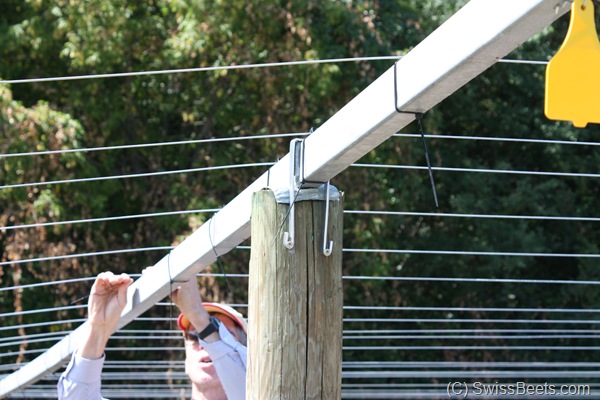
Second, kiwifruit likes part shade. New homes had been built that destroyed the forest and therefore destroyed the kiwifruit’s shade and protection.  To conquer that, their newest system for testing, is a somewhat elaborate, wire pergola.

Hardy Kiwi VineKiwis grow on vines that climb quite vigorously. This pergola system will give the kiwis shade, allow easy harvest and abundant room to spread out and make its own canopy. The pergola is also situated North-South so they’ll be able to test their own suggestions at growing kiwi successfully in colder climates. Most hardy kiwis are able to grow in zones 4-9, but ‘Arctic Beauty’ can grow in zone 3. Researchers recommend a thick layer of woodchips that not only protects the roots at winter, but it also helps keep in moisture during the summer. The result is a much denser and extensive root system, which will help in the growing season.

Kiwi

Kiwi Pergola

Kiwifruit Pergola

University of Minnesota KiwiThis pergola is so high, that it’ll make harvesting a breeze, as the fruit hang down for picking.Kiwi Pergola System

Kiwi Pergola U of M

Arctic Beauty Kiwi The pink-tinged leaf above is from the kiwi called “Arctic Beauty.” In the springtime nearly all the leaves have pink on their tips. This variety can be found in many garden catalogs. It’s hardy to zone 3, hence the ‘Arctic Beauty’ name.

Silver Vine KiwiPictured above is the kiwi called Silver Vine. This is perhaps the only hardy kiwi that changes color once ripe. It’ll turn a golden color when ready for picking, but it’ll also attract Robins.

Kiwi CrossThis is one of their hybrid crosses. It’s 3/4 hardy kiwi, and 1/4 fuzzy golden kiwi. You can already see the drastic size difference in leaves as compared to the regular hardy kiwis. I believe this cross has already survived one winter. Since it’s male, they don’t know how big the the fruits will be until they can get a female ready to produce.

Kiwi VineA tropical expression of foliage that does quite well in negative zero winters.

KiwiAbove is a kiwi vine that’s being trained along a wire T-bar system similar to grapes. Researchers believe their pergola system is better suited for growing kiwifruit however.

Tasting Kiwis Everyone was eager to taste these little fruits. You may spot them in the grocery store occasionally, but it sounds like a few more people are ready to grow their own. You may even want to try them in your garden.